
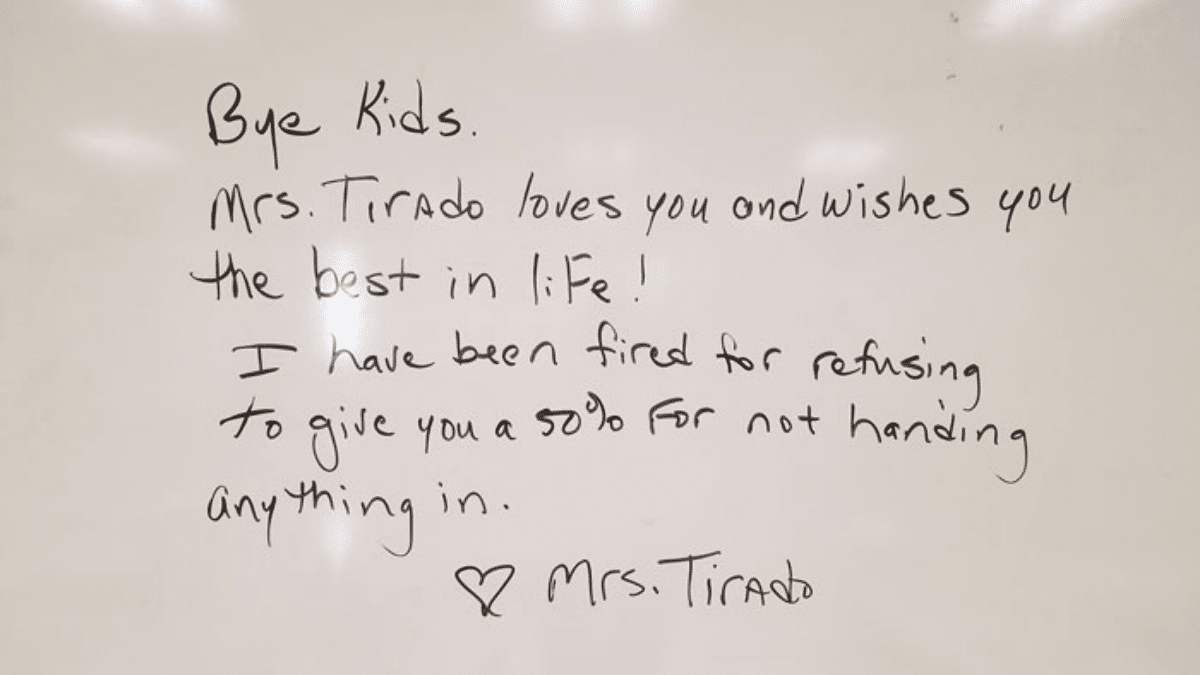
Some South Carolina teachers spent a decade writing a 50 into the gradebook for work that never showed up. This fall, the state told districts they cannot require that anymore.
Students Opened a Different Gradebook
South Carolina students opened the year under a different grading system than the one many of their teachers have used for the past decade. In some districts, a missing assignment still counted as a 50. Teachers could not write the zero the empty work had earned.
That was the floor: a policy that automatically bumped any score below a set threshold, often 50 percent, up to that number, even for work a student never turned in. A 50 for no work is not mercy. It is a grade that pretends something happened.
An Oh My Classroom Facebook post about the ban on Sept. 17, 2026, reached about 120,000 people. Teachers recognized the fight immediately. It is not the Florida zeros story. It is a state law that now tells districts they cannot force the 50.
The Floor Teachers Were Required to Use
A grade floor is a district or school rule that requires a teacher to assign a minimum score, usually 50, on an assignment or a quarterly report card. South Carolina’s passing mark is 60, a D. The floor sat 10 points under that line, so a student who turned in nothing was already most of the way to a pass before any real work landed.
Education Week described how the math was sold: a single zero on a 100-point scale can sink a term, so the 50 was framed as a chance to bounce back. Lexington School District Two, outside Columbia, set a quarterly floor of 50 in 2016. Rob Burggraaf, the district’s senior director of academics, assessment, and accountability, told EdWeek a floor of 50 “creates five equal 10-point distributions on the grading scale,” so an A and an F average to a C.
Greenville County, the state’s largest district, started its floor at the beginning of the 2016-17 school year, the Post and Courier reported. Middle school teachers there had to award at least a 50 on every assignment. A student could earn an A on one major piece, turn nothing else in for the rest of the quarter, and still pass. Elementary and high school floors applied to the quarterly average, not each task.
Sumter County’s floor had been in the teacher grading manual for at least a decade by 2025, the SC Daily Gazette reported, even before the board ever voted it as formal policy. That is the 2015-and-2016 window: not a statewide 50, but a local habit that took hold in some districts around the same years the state moved to a 10-point scale.
What the New Law Forbids
House Bill 5073 is now Act 204. The governor signed it on May 18, 2026. It took effect July 1, 2026, in time for 2026-27.
The core sentence is short. No public school district or public school “may adopt any type of grading system that requires a teacher to assign a minimum grade or score that exceeds the student’s actual performance on required assignments.” Teachers can now assign the grade the work earned, including a zero.
The law has teeth. If a district is found in violation, the State Department of Education “shall withhold ten percent of the school district’s State Aid to Classroom funding.” That is not a suggestion in a guidance memo. It is a cut to the classroom-aid line, in force for this school year.
State Rep. Fawn Pedalino, who introduced the House bill, told an education subcommittee in February, “This is going to make grades matter again.” She added, “We are actually hurting the kids when they get an automatic 50 because that is going to push them through to the next grade when they don’t know the content.”

How Many Districts Had a Floor
The state Department of Education does not keep a roster of grade-floor districts. Those were local decisions. A 2025 Palmetto Promise Institute report is the count Education Week repeated: six of the state’s 80 school districts had posted formal minimum-grade policies, and a survey of administrators identified a dozen more using some version of a grade floor at the high school level.
The six posted names in that report were Greenville, Dillon Four, Oconee, Dorchester 2, McCormick, and Richland One. The survey list was Darlington, Dorchester 4, Lee, Lexington, Marlboro, Newberry, Orangeburg, Saluda, Spartanburg 2, Spartanburg 7, Union, and York 4. Other buildings ran a floor by custom, without a board policy on the website. Later write-ups put the statewide total anywhere from 18 to “around 20” to 22 of 74 traditional districts. The honest version is the one in the report: six on paper, a dozen more at high school, and some schools doing it on their own.
EdWeek noted it is still unclear how many schools will have to rebuild their learning-management settings and parent letters this year. The ones that keep the old floor are the ones staring at the 10 percent cut.
Teachers Said Students Were Gaming It
Districts called the 50 a safety net. Teachers called it a loophole. Sumter County’s own survey, reported by the SC Daily Gazette citing The Sumter Item, found more than 8 in 10 teachers opposed the floor. Teachers who wanted it gone said students were “gaming the system” and were not being prepared for work after school.
Patrick Kelly, a high school teacher who also lobbies for the Palmetto State Teachers Association, told the Gazette: “We are teaching bad habits with grade floors and diminishing the capacity of a grade to accurately report what the students know and can do.” He told lawmakers in February, in remarks quoted by the Post and Courier, “I’ve taught for over 20 years in this state, and I’ve seen time and again that students will either rise to, or sink to, the level of expectations we set for them.”
Sherry East, a Rock Hill teacher and then president of the South Carolina Education Association, told the Gazette the policies “lessen the integrity of a diploma.” Teachers want to help, she said, but they do not want to be forced to post a grade the student did not earn. “Let me let the kid do some extra work or some extra credit if I think the situation merits it.”
Austin Jeffries, Dorchester District Four’s Teacher of the Year, told WRDW the old setup trained the wrong habit. “When you come into the workforce, you have to work in order to get results,” he said. “I feel like it was just a setup for failure because knowing that all I need is a 60 to pass, that’s only 10 points that you need to get in the semester.”
Ryan Dellinger, Palmetto Promise’s education-policy director, put the same point in workforce terms after the House sent the bill to the governor. “Grade Floors do our students a disservice,” he said, “by setting low expectations that do not translate to college or the workforce.”
Thomas Guskey, a University of Kentucky professor emeritus who studies grading, told EdWeek the 50 is a patch on a broken 100-point scale. “You understand the reasonableness of [grading floors] from the mathematics perspective, but you are putting a Band-Aid on an arterial cut,” he said. “There are deeper issues involved. Plus, it just drives teachers nuts.”
The deeper fix can wait. The thing teachers asked for first was simpler: stop making them award half credit for an empty slot.
Credit Recovery and the Rest of the Bill
The floor ban is the line teachers will feel on day one. The rest of Act 204 changes how a student gets a second chance, and what may not be stuffed into a final average.
A student may enter a district credit-recovery course only after submitting all required assignments on the timeline the district already uses. Content recovery has the same gate for the relevant slice of the course. The old path – skip the work, collect the 50s, then recover the credit later – is closed.
Districts also may not require formative assessments under state law, or most district benchmark tests, as part of a final course grade. Those tests are for instruction. They are not a hidden exam. End-of-course tests are carved out. The State Board of Education has to stand up a task force before this school year, report by June 1, 2027, and districts have until 2028-29 to put any Uniform Grading Policy updates in place.
Texas has barred districts from requiring a minimum grade on assignments since 2009. South Carolina’s statute goes further on paper: it covers the required floor itself, ties a missed assignment to credit recovery, and puts a 10 percent classroom-aid penalty behind the rule. That is the law now in force in Palmetto State gradebooks.
Frequently Asked Questions
What did South Carolina ban?
Act 204, effective July 1, 2026, bars any public school or district from requiring a teacher to assign a minimum grade higher than the student’s actual performance on required work. Teachers may record a zero.
What happens if a district keeps a grade floor?
The State Department of Education must withhold 10 percent of that district’s State Aid to Classroom funding. The penalty is in force for 2026-27.
How many districts had a minimum-grade policy?
A 2025 Palmetto Promise Institute report found six of 80 districts had posted a formal floor, and a survey of administrators identified a dozen more using some version at the high school level. Later tallies run from 18 to 22, because some schools ran a floor by custom.