
Florida teacher Diana Tirado was fired in September 2018, three weeks into a new job, after she refused her school’s “no zeros” policy and gave zeros to students who submitted no work — then left a viral farewell message on her classroom whiteboard.
What does it feel like to walk out of your classroom for the last time — knowing you’ll never come back? For most teachers, that moment comes at the end of a long career: retirement parties, students lining the hallway, decades of memories. For Diana Tirado, it came three weeks into a brand new school year.
She had spent 17 years in education. She believed in holding students accountable — not as a punishment, but as preparation for a world that wouldn’t give credit for work that wasn’t done. When she took a new position teaching eighth-grade social studies at West Gate K-8 School in Port St. Lucie, Florida, she brought those 17 years of conviction with her.

Early in the 2018–2019 school year, Tirado assigned her students an explorer notebook project — a substantial piece of work she gave them two full weeks to complete. The instructions were clear. The timeline was generous. She had done what teachers do: set an expectation and given every student every opportunity to meet it.
When the deadline passed, some students hadn’t handed anything in. Not a rough draft. Not a partial attempt. Nothing.
Tirado did what any teacher with 17 years of experience and a firm belief in accountability would do. She went to her administrators and asked what grade she should give to students who had submitted no work at all.
The answer she received would change everything.
The Policy Nobody Told Her About

West Gate K-8 had a “no zeros” policy. It was written into the school’s student and parent handbook: the lowest grade any student could receive — for any reason, including not submitting work at all — was 50 percent.
Tirado refused.
She gave the students zeros. On September 14, 2018, she was terminated. She had been at the school for less than a month.
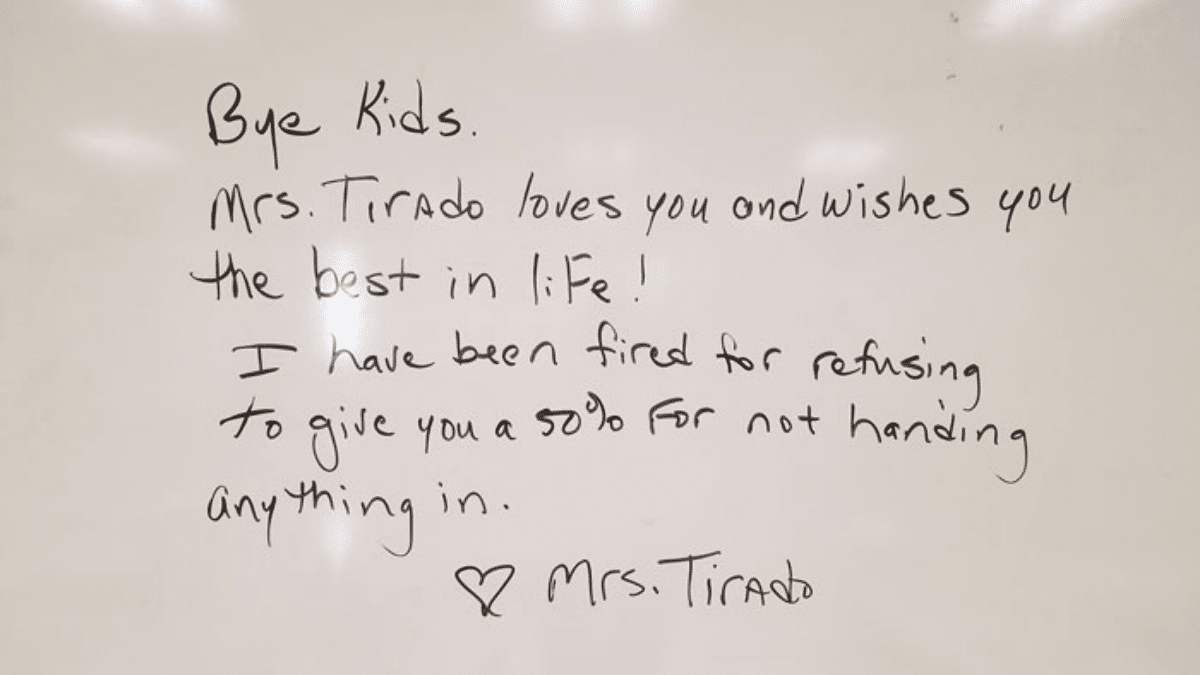
Before she left, Tirado walked to her classroom whiteboard and wrote a message to her students. It read: “Bye, kids. Mrs. Tirado loves you and wishes you the best in life! I have been fired for refusing to give you a 50% for not handing anything in.”
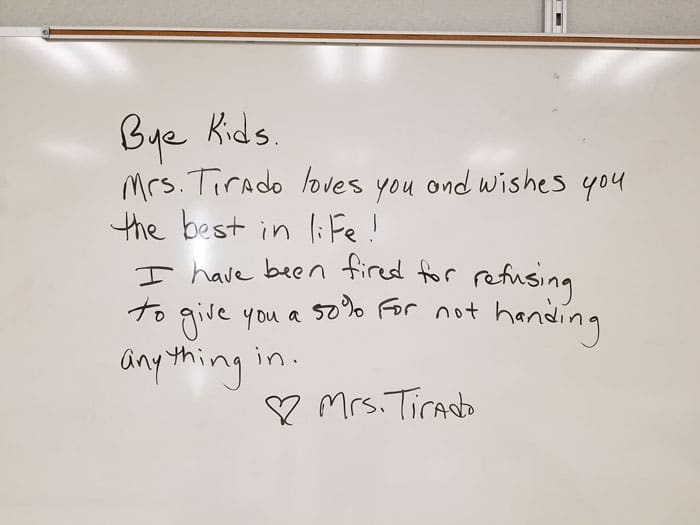
She posted a photo of the whiteboard on Facebook. It was shared hundreds of thousands of times.
The School Tells a Different Story
The St. Lucie County School District did not stay quiet. In a public statement, the district said Tirado’s termination had nothing to do with the grading policy alone. “Ms. Tirado was released from her duties as an instructor because her performance was deemed sub-standard,” the district said, adding that her interactions with students, staff, and parents “lacked professionalism and created a toxic culture on the school’s campus.” Multiple student and parent complaints were cited.
Tirado was still in her probationary period, which meant the school was not required to state a cause on the termination letter. It listed none.
Whether the district’s broader concerns were legitimate or a post-hoc justification for firing a teacher who pushed back on policy, no one outside the school can say for certain. What is certain is that Tirado’s version of events — written in permanent marker on a whiteboard — struck a nerve with educators, parents, and journalists across the country.


The ‘No Zeros’ Debate: Two Very Different Views
The policy that cost Tirado her job is not unique to West Gate. Minimum-grade policies exist in school districts across the United States, and they come from a genuine place of educational concern. Supporters argue that a zero — particularly for a single missed assignment — can mathematically destroy a student’s grade for an entire term, making recovery feel impossible and increasing dropout risk. In a percentage-based system, a 0 out of 100 drags a student’s average down far more steeply than any other grade on the scale. The intent is to keep struggling students in the game.
But critics — and Tirado is one of the most visible — argue that awarding half-credit for work never submitted sends a damaging message. “I’m so upset because we have a nation of kids that are expecting to get paid and live their life just for showing up,” she told WPTV after her firing. “And it’s not real.” In her view, a zero is not cruelty — it is honesty. It reflects a real-world consequence that students will encounter long after they leave school.
Grading researchers point out that the debate is more nuanced than either side often acknowledges. A zero on a 100-point scale is mathematically disproportionate — it represents a range six times larger than any other letter grade. Some educators advocate for a 0–4 scale, or for separating academic grades from behavioral consequences like missing work, as a way to give accurate feedback without mathematically burying a student who had one bad week.
What This Means for Teachers in the Classroom
Tirado’s story resonated so deeply because it captures a tension that countless teachers navigate every day: the gap between what a school’s written policy says and what a teacher’s professional judgment tells them is right. Most teachers will never face termination over a grading dispute. But many will find themselves in rooms where their instincts about accountability conflict with administrative directives designed around different priorities — retention rates, parental satisfaction, the appearance of student success.
Knowing your school’s grading policy — and where it comes from — matters. If your school has a minimum-grade policy, ask what the research behind it is and how it’s applied consistently. If you disagree, document your concerns and raise them through proper channels before a single assignment becomes a termination. Tirado says she didn’t know about the policy until after she’d already made her decision. That gap between what’s in the handbook and what teachers are actually told on day one is where most of these conflicts begin.
As for Diana Tirado: after her story went viral, she continued to speak publicly about grading policy reform. Her whiteboard message — written in the final minutes of a job she’d just lost — became one of the most widely shared images in recent education news. She never got her job back. But she did get a platform.
Frequently Asked Questions
Why was Diana Tirado fired?
She refused to follow her school’s “no zeros” policy and gave students actual zeros for submitting no work at all, rather than the district-mandated minimum grade of 50%. She was terminated on September 14, 2018, less than a month into the job.
What did the school say about her firing?
The St. Lucie County School District said Tirado’s termination wasn’t only about the grading policy, citing unprofessional conduct and complaints from students, parents, and staff. Tirado disputes that characterization.
What is a “no zeros” grading policy?
A minimum-grade policy, common in some U.S. school districts, that sets a floor (often 50%) on any grade regardless of whether work was submitted — intended to prevent a single missed assignment from mathematically destroying a student’s overall average.
2 Responses