
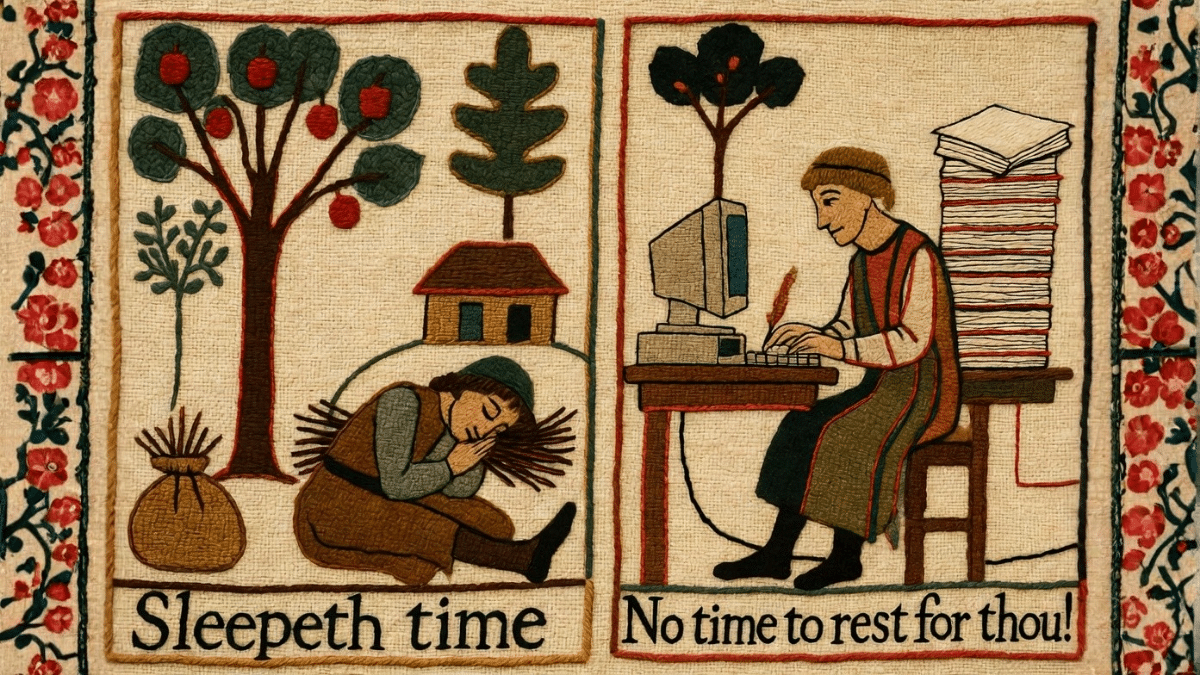
Historical records show medieval English peasants worked roughly 120-150 days a year, with nearly a third of the year off for religious and community holidays — while modern U.S. teachers routinely log 50+ hours a week with no national guarantee of paid leave.
Part I – Two Calendars, Two Worlds

You probably haven’t spent too much time dwelling on the life of a medieval peasant…. why would you? But if you had, you would probably imagine a tiresome life of endless drudgery: forever digging, planting and harvesting in cold muddy fields from dawn to dusk, hungry pangs nagging, and very little happiness in between. And you? The modern school teacher? A well-lit classroom, 8-5, surrounded by books, technology and, touch wood, a regular paycheck.
Yet when you step back and compare the time spent working hour-to-hour, day-to-day and even month-to-month, the data reveals something genuinely surprising: medieval peasants worked less than teachers do today — and by more than you might think.
According to historians who have extensive records from 13th–14th century English manors, many medieval peasants worked roughly 120 to 150 days a year on the land, sometimes up to about 175 days for servants. The rest of the year was taken up by winter slowdowns, poor weather and, crucially, by a calendar packed with religious and community holidays. Christmas, Easter, midsummer and a long list of saints’ days were not just church obligations; they were enforceable days of rest. On top of that came weddings, wakes and village “ales” – extended beer-fuelled gatherings marking births, marriages and other milestones (Let’s be honest, many teachers today STILL participate in these!).
Economist Juliet Schor, in her work on historical labor patterns, notes that “the tempo of life was slow, even leisurely; the pace of work relaxed.” In many places, total holiday and rest time amounted to about one-third of the year.
Now step into a modern public school in the United States. On paper, a teacher’s year looks generous: roughly 180 instructional days, plus professional development days and a summer break. As we all know though, most teachers’ work calendars actually expand well beyond the official contract. The school year spills into August for planning and stretches into late June with exams, grading and end-of-year reporting. Many also work in summer school, tutor, or take on second jobs to make ends meet.
And incredibly, unlike medieval peasants, teachers have no national guarantee of paid vacation. Federal law does not guarantee paid holidays or leave, and district calendars vary widely. Breaks such as Thanksgiving, winter vacation and spring break may be vacations for students, but teachers frequently use them to catch up on all those little (or sometimes big) jobs that slip by during term time. In medieval times, the church effectively forced peasants to stop working; modern-day teachers? Forget it!
Measured purely in days not spent working, the peasant’s calendar can look strangely generous beside the teacher’s crowded school year.
Part II – A Day in the Life
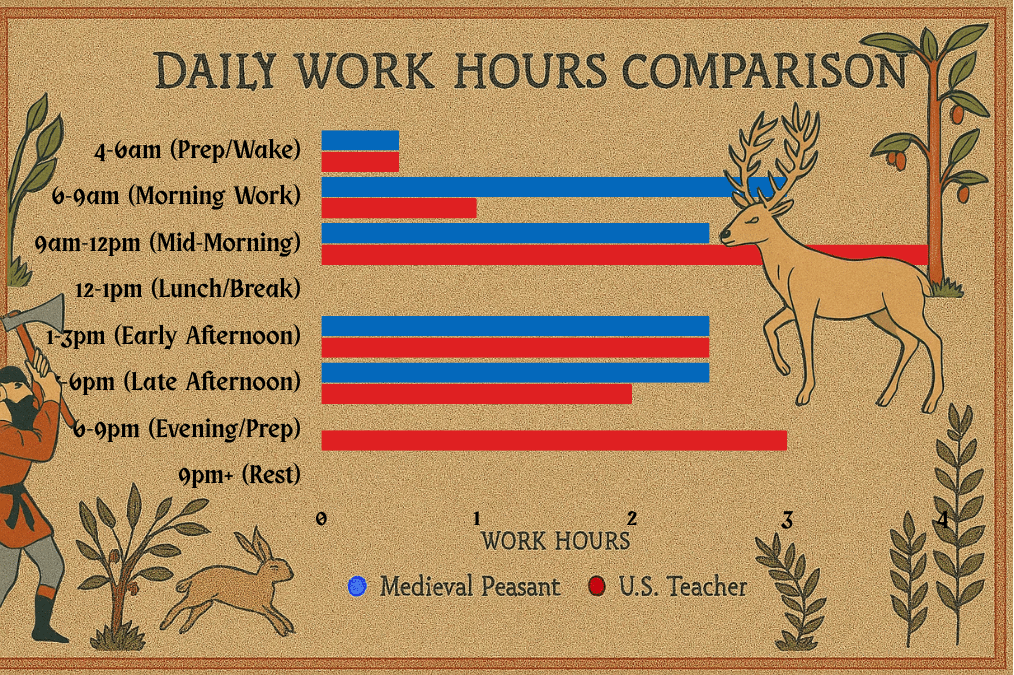
The contrast is just as sharp when you zoom in from the year to a single day.
For a peasant, the day followed the sun and the season. In summer, work would run from dawn to dusk, but it was changeable. A 16th-century bishop, describing laborers of his time, complained that “a good piece of the day is spent afore he come at his work,” and that by the first stroke of the evening clock, the worker “casteth down his tools, leaveth his work.” Between those points lay long meal breaks, an afternoon nap, and pauses for mid-morning and mid-afternoon snacks. Bad weather could halt work entirely.
Now don’t go resigning just yet—this was hard, physical labor, and life expectancy was short. But the working day itself was punctuated by plenty of stopping points. There was no expectation that a peasant would continue threshing by candlelight or wake at midnight to “just check on the fields.”
A modern teacher’s day, by contrast, looks very different.
It often begins before 7 a.m., with a quiet kitchen table turned into an impromptu planning office. By the time the first bell rings, the teacher has already read and sent emails, tweaked a lesson, photocopied materials and, in many cases, responded to messages from parents or administrators.
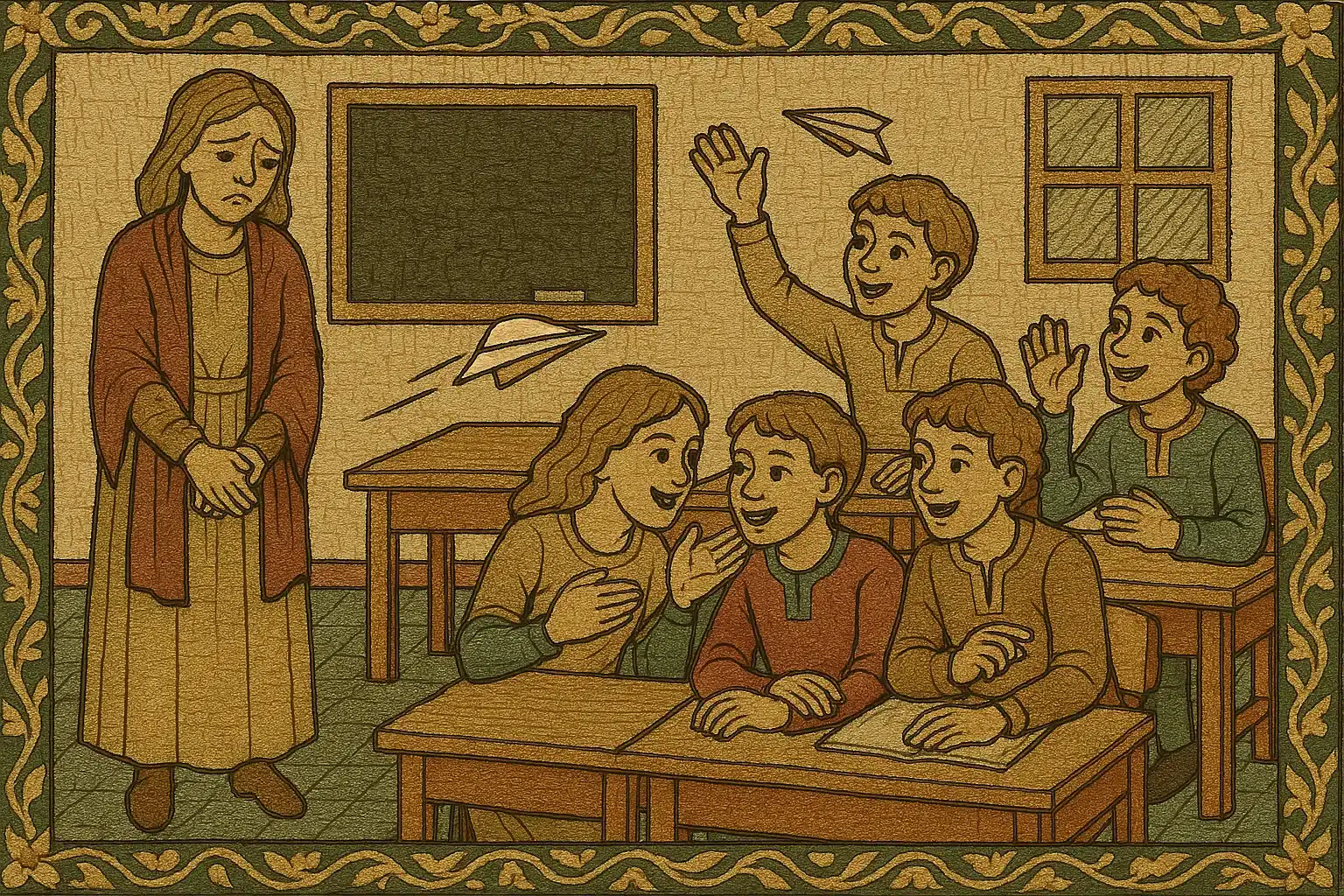
And once classes begin, the day becomes a continuous mental grind: five or six periods of 20–30 students each, shifting gears from algebra to essay writing to classroom management. Sure, official breaks exist—usually a short lunch and a planning period—but they are easily swallowed by duties, meetings, urgent student needs, or just the desire to use ANY spare moment to chip away at the never-ending mountain of paperwork. It is not unusual for teachers to eat lunch standing at the back of their own classroom.
When students go home, the peasant’s equivalent of “down tools” never applies. Afternoons spill into after-school clubs, coaching, extra help sessions and parent meetings. Evenings bring grading, data entry, lesson revisions and online communication. Surveys over the past decade have repeatedly found that many U.S. teachers easily work 50 hours a week or more, once unpaid evening and weekend labor is included.
Where the peasant’s day was physically punishing but rhythmically broken, the teacher’s day is less dangerous but far longer AND unrelenting, especially in mental and emotional terms.


Part III – What the Comparison Really Tells Us
At this point, it is tempting to declare the medieval peasant the unexpected winner of the work–life balance contest. The story, of course, is more complicated.
Peasants faced threats that teachers (in the first world, at least) do not: risk of famine, extremely basic or zero medical care, little legal protection and a social order that allowed very little mobility. Leisure did not mean luxury. It meant surviving winter in a cold house with limited food and no safety net if the harvest failed.
Teachers, by contrast, work within a system that—despite its flaws—offers salaries, health insurance in many districts, and the chance to change jobs or careers. Their work is intellectually demanding, emotionally intense and often under-resourced, but it is also tied to purpose: helping children learn, stabilising communities, and giving structure to families’ lives. Quiet acts of dedication — like the teacher who styled her student’s hair every morning after the child lost a parent — show just how far above and beyond most teachers are willing to go.
What the comparison really highlights is not that medieval peasants “had it better,” but that modern expectations around work and rest are historically unusual. For much of human history, work was organized around natural cycles and collective rituals. Periods of intense effort were followed by enforced pauses. The industrial era, and later the digital one, replaced that with something more linear: a belief that a good worker is always available, always responsive, always “on.”
Teachers sit at the sharp end of that shift. They carry the emotional load of students’ lives, the bureaucratic load of modern schooling, and the cultural expectation that they will do it all “for the kids” without complaint. In that sense, the modern teacher has become a kind of secular saint—admired in theory, overburdened in practice.
Looking back at the medieval calendar does not offer an easy blueprint for reform. No one is arguing for a return to feudalism, or for tying teachers’ schedules to saints’ days and harvests. But it does suggest that rest is not a modern indulgence; it is an old necessity that we have progressively sidelined. This is particularly stark when we see how academic pressure has crept all the way down to kindergarten, with five-year-olds now expected to meet standards once reserved for older grades.
For teachers, the lesson may be both personal and political. Personally, it is a reminder that protecting evenings, weekends and holidays is not selfish, but part of a long human tradition of balancing effort with recovery. Politically, it raises a harder question for policymakers and school systems: if peasants in an age of famine could count on mandated pauses, why is it so difficult to guarantee sustainable workloads and predictable time off for those standing in front of our children today?
The fields and the classroom could hardly be more different. Yet across the centuries, they share a truth: work without genuine rest eventually exhausts the worker—and, in time, the society that depends on them.
Frequently Asked Questions
How many days a year did medieval peasants actually work?
Historical records from 13th-14th century English manors show roughly 120-150 days a year for most peasants, up to about 175 days for servants — with the rest taken up by religious holidays, community events, and weather-forced downtime.
How many hours do teachers work today?
Surveys have repeatedly found many U.S. teachers work 50+ hours a week once unpaid evenings and weekend labor — grading, planning, communication — are included.
Do teachers get guaranteed paid vacation?
No — unlike medieval peasants’ enforced holidays, U.S. federal law does not guarantee teachers paid holidays or leave, and policies vary widely by district.