

Texas and West Virginia both just signed sweeping new laws letting teachers remove disruptive students from class — and they’re not the only ones. At least five states have overhauled their discipline laws since 2020, driven by federal data showing teacher behavior complaints have climbed sharply since the pandemic.
Two States, One Message This Summer
For years, teachers across the country have said the same thing in survey after survey: student behavior is getting harder to manage, and they don’t have the tools to deal with it. This year, two state legislatures answered — loudly.
Texas and West Virginia both passed major overhauls of their school discipline laws, giving teachers significantly more power to physically remove disruptive students from their classrooms. On the surface, they look like two unrelated state stories. Look closer, and they’re the leading edge of a much bigger shift in how American schools are being told to handle misbehaving kids.
What Texas Just Handed Teachers
Texas’s House Bill 6, dubbed the “Teacher’s Bill of Rights” by its author, state Rep. Jeff Leach (R-Allen), took effect for the 2025-2026 school year and rewrote large parts of the state’s school discipline code.
Under the old rules, a teacher could only remove a student from class if the behavior was documented as repeatedly disruptive. Under HB 6, a single incident is enough — if a student is unruly, disruptive, abusive, or bullies a classmate, a teacher can send them out immediately. Once removed, a student can’t return to that classroom without the teacher’s written consent and an agreed-upon return-to-class plan.
The bill also reverses part of a 2017 law that banned out-of-school suspensions for the youngest students: third graders and up can now be suspended for repeated, serious classroom disruption or behavior that threatens other students’ safety. In-school suspension, which used to be capped at three days, now has no time limit, though a review committee must check in on the student every 15 days.
“This bill restores the rights of our educators and our teachers, in conjunction with parents, to provide those consequences and to provide the necessary controls,” Leach said while the bill moved through the House.
Not everyone is on board. Disability rights advocates have warned that expanding removal authority without stronger due-process safeguards could disproportionately hit students with disabilities, who are already removed from class at higher rates than their peers.
West Virginia Went Even Younger
If Texas’s law was aimed broadly, West Virginia’s Senate Bill 199 zeroed in on the age group teachers say is struggling the most: elementary schoolers, including kindergartners.
Signed by Gov. Patrick Morrisey and sponsored by Sen. Amy Grady (R-Mason) — herself an elementary school teacher — SB 199 lets K-6 teachers immediately remove a student who is violent, threatening, or so disruptive that it’s blocking other kids from learning. That’s new: before this law, West Virginia had essentially no formal discipline process at all for its youngest students.
The law isn’t just about removal, though. Every removed student gets referred to a counselor or social worker to look for an underlying cause, and the school has to build a two-week behavior plan around them. If a student is pulled from class three times in one month, they’re moved to in- or out-of-school suspension, or in more serious cases, an alternative learning center.
“The legislation creates a streamlined process for K-to-12 teachers when dealing with violent student behavior,” Morrisey said at the signing.
Grady, who tried and failed to pass a similar bill the year before, called the final version more thoughtful than her first attempt: “It gives a little more clarification in what we need to do with students in particular situations. It’s not a cookie cutter approach.”
Kristie Skidmore, president of the American Federation of Teachers in West Virginia, backed the bill but flagged a real gap: fewer than half of the state’s 55 counties actually have an alternative learning center to send repeatedly removed students to. “While no bill is perfect, these bills are a great step in the right direction,” she said — resources still need to be funded to make good on it.

This Isn’t Just Two States
Texas and West Virginia are the biggest, most recent examples — but they’re part of a wave that’s been building for years. A University of California Law–San Francisco analysis tracking discipline legislation found that state lawmakers have proposed 61 separate bills expanding exclusionary discipline since 2020, across 25 states, with 12 already signed into law as of last year.
Iowa is the newest addition, and arguably went further than either Texas or West Virginia in one respect: under its new law, a teacher can flatly refuse to let a removed student back into their classroom, and a review committee can’t override that decision if the student assaulted the teacher. Students removed a second time in a semester face five consecutive days of in-school suspension.
Alabama got here first, passing a statewide “Teacher’s Bill of Rights” back in 2024 that became something of a model for what followed — it was the first state to hand teachers, rather than just administrators, direct authority to remove students for defined “disorderly conduct.” Arizona took a different route, repealing a law that had banned suspending kindergarten through fourth-grade students entirely; those students can now be suspended up to 10 days a year.

Why Now: The Data Behind the Push
None of this is happening in a vacuum. Federal survey data backs up what teachers have been saying anecdotally for years.
In a 2025 National Center for Education Statistics survey, 76% of elementary school leaders said they “agree” or “strongly agree” that the pandemic has continued to negatively affect students’ behavioral development. Separately, the share of elementary schools where staff say they need more training on classroom management jumped from 51% in May 2022 to 65% the following year. EdWeek’s most recent teacher survey found nearly two-thirds — 64% — say student behavior has gotten “a lot” or “a little” worse in just the past year.
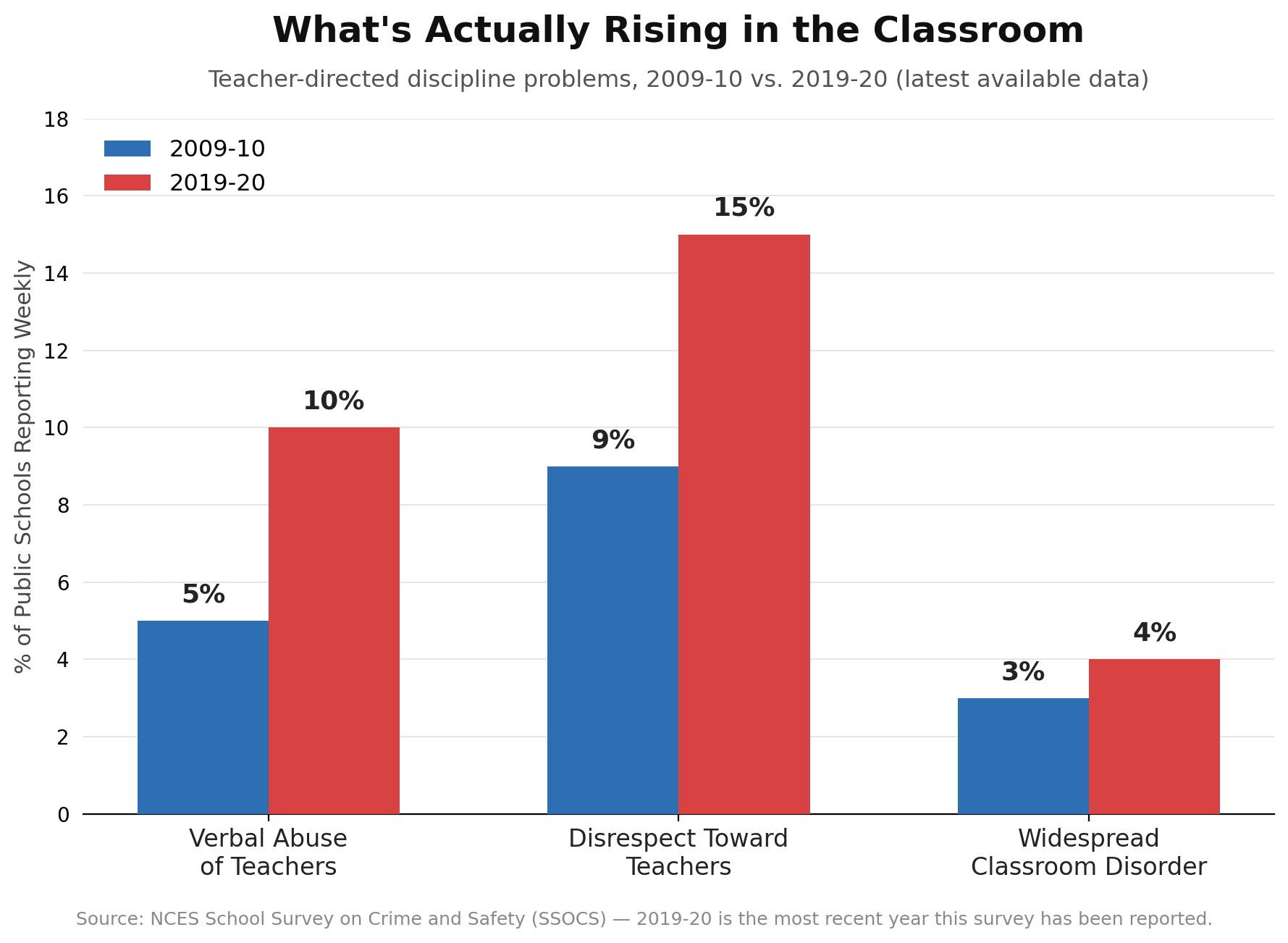
Zoom in on what kind of misbehavior is actually increasing, and a clearer pattern shows up: it’s complaints aimed directly at teachers. NCES’s School Survey on Crime and Safety — last administered for the 2019-20 school year, still the most recent breakdown by type — found that verbal abuse of teachers doubled over the previous decade (5% of schools reporting it weekly in 2009-10 to 10% in 2019-20), disrespect toward teachers climbed from 9% to 15%, and reports of widespread classroom disorder ticked up from 3% to 4%. Over that same stretch, student-on-student bullying actually declined.
The political backdrop matters too. In April 2025, President Trump signed an executive order calling for a return to “common sense school discipline policies,” which rescinded federal guidance that had pushed schools to watch for racial disparities in who gets suspended or expelled. That order didn’t force any state’s hand, but it removed a federal counterweight that had been pulling in the opposite direction for a decade.
Not Everyone’s Convinced This Is the Right Fix
Not every state — or every school — is reaching for the same tool. Some districts are betting on the opposite approach: more support staff instead of more suspensions.
In Texas, ironically the same state that just passed HB 6, the International Leadership of Texas charter network went the other direction, hiring additional behavior coaches after seeing a post-pandemic spike in “pretty severe behavior issues,” according to assistant superintendent Laura Carrasco. Every K-8 school in the network now has three counselors, and a teacher struggling with a student can get one in their classroom within 90 seconds.
Researchers who study “restorative practices” — group conversations aimed at resolving conflict instead of removing the student who caused it — say the approach can improve both behavior and academic performance when it’s implemented well. The catch, and it’s a real one: rolling it out takes money, staff, and buy-in that not every district has, which is part of why lawmakers under pressure from teachers keep reaching for removal authority instead — it’s cheaper and faster to legislate than to fund.
What This Means for Classrooms This Fall
For teachers in Texas and West Virginia, the change is immediate: both laws are in effect for the 2025-2026 school year that just started. For everyone else, the direction of travel is clear even if the timeline isn’t. With 25 states having already floated similar bills and more governors facing the same teacher-retention and behavior-complaint pressure, this isn’t likely to stay a two-state story for long.
The open question isn’t really whether more states follow — it’s whether they pair the new authority with the counselors, alternative learning centers, and funding that teachers, unions, and researchers all agree actually make it work.
Frequently Asked Questions
What does the new Texas law let teachers do?
Texas’s House Bill 6, in effect for the 2025-2026 school year, lets a teacher remove a student from class after a single incident of unruly, disruptive, or abusive behavior. Suspension is now allowed starting in third grade, and in-school suspension no longer has a time limit.
What does West Virginia’s law change?
Senate Bill 199 lets K-6 teachers immediately remove a violent, threatening, or severely disruptive student. Removed students are referred to a counselor and given a two-week behavior plan; three removals in a month trigger suspension or placement in an alternative learning center.
Are other states doing this too?
Yes. At least 25 states have proposed similar bills since 2020, with 12 already enacted as of last year — including Iowa’s 2025-2026 law, which lets a teacher permanently bar a student who assaulted them from returning to class. Alabama and Arizona passed earlier versions in 2023-2024.
6 Responses
I earned my teaching degree in December 1974. Two days after that I was called to substitute in my home school district. Since then, I’ve taught in a Montessori school, spent 18 years teaching kindergarten in PWCS, done private tutoring while my daughter was tiny, done several long term substitute teaching as part of my retirement. So I’ve seen some pendulum swings. I can definitely attest to the changes in student behavior since the pandemic. Nobody has self control, awareness, discipline anymore. I volunteer at my school for the Book Fair and the RIF distribution because we’re a Title 1 school. Teacher morale and respect has diminished significantly. Creativity, and the joy of watching the “Readiness “ has disappeared. Free choice time in kindergarten has gone. Bubbling in and data collection has become the norm. Kindergarten has become “Little Second Grade”. I have actually attended a workshop where we were taught how to teach children to play!!!!! I’m so very grateful that I taught when I did. I’m also grateful that I was able to retire when I could not live with myself and teach the way I knew was totally wrong.
Both approaches are needed. More support staff and counseling can make a huge difference, especially with the right staff members. However, teachers need to be able to remove a student from class occasionally. Tolerating disruptive behavior sends the wrong message to students. They need to see there are consequences. Parents need to be part of the process too if possible, not just informed later that there was a problem.
As an 18 educator within special education and a PhD in the field, it may seem counterintuitive for me to argue the point made by Disability Advocates near the end of the Texas portion of the article. I’m an advocate, too. I agree wholeheartedly with the changes Texas has made and here’s why: Typically, a general education classroom has several students receiving special education services on the roster. Concern about a student with services being removed from the learning environment is valid. However, the same concern needs to be extended to the other students with services who are the most vulnerable when it comes to focusing and accessing instruction. Certainly the general education students deserve their Free Appropriate Public Education (FAPE) as well. But I’m still addressing the Disability Advocates. Back to the classroom; let’s say there’s a student who struggles with ADHD and constant behavior interruptions from a peer repeatedly break his delicate focus. Maybe there’s an another student with a medically diagnosed anxiety disorder and just hearing a peer bully someone, or use age inappropriate or sexualized language causes her to shut down and need to call home. Maybe there’s another student learning to manage her behavior and doing superbly until a peer loses his temper or yells at the teacher triggering the previously self-regulated student to join in. These are real life scenarios. A single student should not have the opportunity to negatively impact the learning environment. Period. For years teachers have been forced to “deal with it,” “work on relationship building with that student.” What about the other student relationships lost due to not being able to trust their teacher can protect them from that one disruptive student? It pains the adults contemplating the issues. I understand that. But holding students accountable is truly the purest form of equity.